
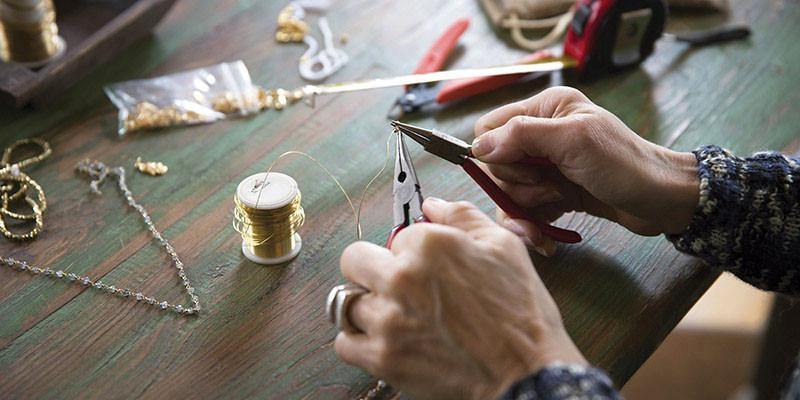

ALL ABOUT ARTISTIC WIRE
In our previous BLOG, we talked about Beading Wire – a little more complex than one might think, as you might have discovered. In this BLOG we will discuss Artistic Wire that can be used to create absolutely fabulous designs in jewelry making. Not to be missed, please read on to learn about this fabulous type of wire to compliment your designs!!
ARTISTIC WIREFlexible, Bendable, Shapeable
Jewelry wire is typically offered in three levels of hardness: Dead Soft, Half Hard, and Full Hard. A metal’s hardness is basically a measure of how much it resists bending, so that is an important factor in making wire jewelry.
Artistic Wire is considered "dead soft" on the wire hardness scale, because it is bendy and pliable. ‘Dead soft’ (or just ‘soft’) means the metal offers little or no resistance – it’s very easy to bend.
Artistic Wire comes in two basic types, a permanent-coloured copper-core wire, and a silver-plated coloured copper wire. Soft and flexible, this wire bends easily, retains its shape, and is attractive and non-tarnishing. The process has been developed to resist tarnishing, chipping, or peeling. It will stand up to all the wire wrapping, coiling, and twisting you're about to put it through!
The colours are vibrant and permanent - having a polyurethane coating. This particular type of wire is not meant for the soldering process.
NOTE: Soldering joins two pieces of metal, such as electrical wires, by melting them together with another metal to form a strong bond. Many people use this technique in their field, from electrical engineering and plumbing to jewelry and crafts. In a delicate procedure, a special material, called solder, flows over two pre-heated pieces and attaches them through a process similar to welding or brazing.Artistic Wire is available in a variety of styles: round, flat, braided, twisted and mesh. The unique styles will inspire such a diversity of jewelry creations!
The gauge (GA) of the wire is so important. As the gauge of the wire increases, the diameter of the wire decreases. As an example 16 gauge wire is much larger than 22 gauge. As the jewelry wire gets larger in diameter, or the gauge gets smaller, and the wire becomes harder to bend. Simply put, it is easier to bend thin wire than it is to bend thick wire.In general, wire components for earrings are made in 20 gauge wire, wire components for bracelets are made in 18 or 20 gauge wire, and wire components for necklaces are made in 16 or 18 gauge wire. Rings are often made with 12 or 14 gauge wire and stand up to wear. To help you remember how wire size gets smaller as the gauge increases, just remember that zero gauge wire is about the thickness of your little finger and 30 gauge wire is extremely fine, slightly thicker than a heavy sewing thread.
Artistic Wire is available in a variety of gauges (thickness), the most common as follows:
|
|
|
*Remember that 10 GA (the lower number) is much thicker than 34 GA (the higher number).

The colour variety available in Artistic Wire is just astounding! Following is just a sampling of the colour assortments:
|
|
|
|


Working with Artistic Wire can become totally addictive. In our next BLOG we will discuss and demonstrate different ways to use Artistic Wire – there are so many techniques and uses! You are going to love it so stay tuned!

Leave a comment
Comments will be approved before showing up.